
Personal Trainer Level 4 (EQF 4) – Face-to-Face
About Course
Course Details:
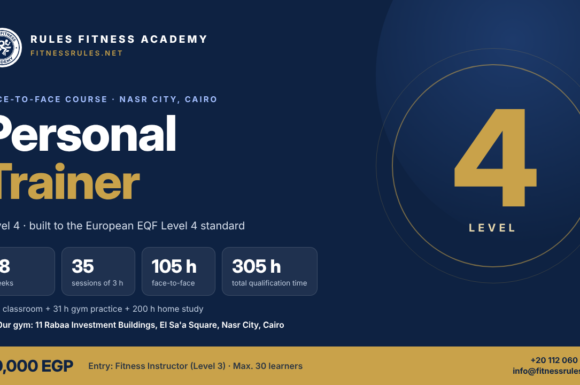
- Delivery: Face-to-face only, in our classroom and gym (no online lessons)
- Total Qualification Time: 305 hours
- Guided Learning Hours (face-to-face): 105 hours (74 classroom + 31 practical in the gym)
- Home study: 200 hours
- Course duration: 18 weeks (approx. 4 months)
- Total Lectures: 35 sessions of 3 hours (two per week)
- Entry requirements: Age 18+, a high-school diploma or equivalent, and a Fitness Instructor EQF Level 3 qualification (or equivalent)
- Class size: Maximum 30 learners (gym practice in groups of max. 10 per tutor)
- Course Price: 30,000 EGP
- Venue: 11 Rabaa Investment Buildings, El Sa’a Square, Nasr City, 4th Floor, Cairo, Egypt
What you will study
| Section | Topics | Face-to-face hours | Home study hours |
|---|---|---|---|
| 1. Role of the Personal Trainer | Know the professional code of practice, related ethics, and required national standards related to personal training; Understand the importance of professional presentation and customer service; Outline established physical activity and fitness guidelines; Summarise a range of components involved in healthy lifestyle promotion; Understand how to develop and deliver personal training services | 10 | 15 |
| 2. Functional Anatomy | Understand the functional anatomy of the skeletal system, bones, and joints; Understand functional kinesiology and the biomechanics of the body in relation to health and fitness; Understand the anatomical structure and function of the muscular system in relation to health and fitness | 10 | 20 |
| 3. Physiology | Understand the role of the energy systems in relation to health and fitness; Understand the role of the cardiorespiratory system in relation to health and fitness; Understand the role of the nervous system in relation to health and fitness; Understand the role of the endocrine and immune systems in relation to health and fitness | 10 | 20 |
| 4. Fundamentals of Nutrition Advice | Understand the basic food and nutrient groups and their recommended consumption levels for general health; Understand how to adapt dietary advice to benefit health, weight loss, and exercise-related objectives; Understand personal trainer professional scope of practice regarding nutrition advice | 10 | 20 |
| 5. Psychosocial Aspects of Health and Fitness | Understand and apply the components of effective communication and building rapport; Understand the principles of motivation and behaviour change in supporting customer goal achievement | 9 | 16 |
| 6. Health and Fitness Assessment: Collecting and Analysing Information | Understand somatotype and the components of fitness; Understand and apply a range of methods for gathering and analysing customer information related to health and lifestyle; Understand and apply a range of fitness assessment methods for gathering and analysing customer information related to customer objectives | 20 | 30 |
| 7. Training Adaptation and Exercise Planning and Programming | Understand the principles that underpin programming for fitness training and physical adaptation; Understand the programming guidelines and best practice for various types of structured exercise and fitness training; Apply the guidelines and principles of periodisation and cardiorespiratory training to programme design; Apply the guidelines and principles of muscular resistance training to programme design | 20 | 40 |
| 8. Delivery of Personal Training Services | Understand and apply effective coaching and instructional skills to a personal training session; Understand and apply the use of relevant technology to physical activity and exercise | 8 | 22 |
| 9. Business and Marketing Skills for Personal Trainers | Understand how to establish and prepare a plan for a personal training business; Understand and apply effective business and marketing skills to a personal training business | 8 | 17 |
How you are assessed
- Four multiple-choice tests, taken in class
- Two worksheets (Role of the Personal Trainer; business and marketing)
- Three written case studies (nutrition, behaviour change, health and fitness assessment)
- Assignment: design a periodised training programme
- Observed practical: client consultation and fitness assessment
- Practical assessments of the CV method, advanced training systems and stretching methods
- Final 1-2-1 practical assessment with a real client, followed by your own session evaluation
- Final theory exam (2.5 hours) and a final case study (home study)
You receive the assessment criteria before you are assessed, verbal feedback after every practical assessment, and a copy of your completed checklist.
Your tutors
- Coach Ahmed Ali – Academy Director – tutor and assessor
- Coach Nada El Sherief – Head of Instruction – tutor, assessor and internal quality assurer
- Nada Mostafa – Nutrition tutor (MSc Biological Sciences and Sports Health)
- Asmaa Hatem Fayed – Nutrition tutor (BSc Dietetics)
- Coach Amr Abdelkareem – Practical tutor and assessor
Your certificate
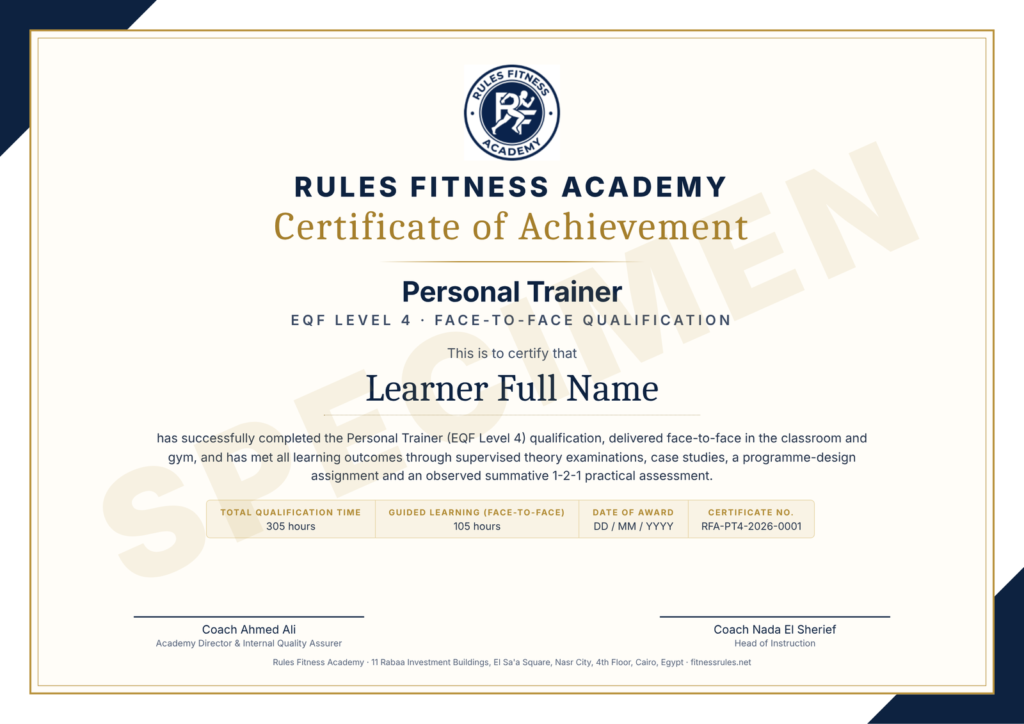
On successful completion you receive the Rules Fitness Academy Personal Trainer (EQF Level 4) certificate showing the qualification, EQF level, hours and a unique certificate number.
Course Accreditation
Our course is currently in the EuropeActive accreditation process
- About EuropeActive
Europe Active is the leading (non-profit) organization representing the European health and fitness sector in Brussels. In parallel with its significant economic contribution, the sector has an important role to play in creating a more active and healthy Europe. Europe Active aims to cooperate with the European Union and other international organizations to achieve its objectives.
More than 200 experts from across Europe have developed EuropeActive’s educational standards which identify the knowledge, skills and expertise necessary to work in a number of fitness occupations. RULES FITNESS ACADEMY has used the EuropeActive standards to develop training programs which ensure their graduates are best equipped to succeed within the fitness industry across Europe. The course of study you are about to undertake has been designed to be fully aligned with EuropeActive’s educational standards and has been submitted to EuropeActive for accreditation.
As part of Europe Active, the European Register of Exercise Professionals (EREPS) is an independent registration process for all instructors, trainers and teachers working within Europe in the fitness sector. Meeting EuropeActive’s educational standards has been agreed as the minimum requirement for an individual to be called an exercise professional and to make them eligible for registration with (EREPS).
Registration with EREPS ensures that exercise professionals have met the recommended minimum standards of good practice and are qualified to do their job. All EREPS members must abide by a Code of Ethical Practice and are committed to raising standards through a professional continuing education or lifelong learning process.
The benefits of EREPS membership include:
- A license to practice – a public register of trainers, trainers and teachers working in the European health, fitness, and physical activity sector
- Being part of a community of like-minded professionals – provides opportunities to interact with other professionals at EREPS events and through their social media channels
- Job mobility – EREPS is globally recognized with members currently working in 28 countries
- A source of information – EREPS events, website blog and newsletter provide access to current industry news and best practices
- Real value – the EREPS affiliate scheme, provides discounts on personal training equipment and services
- Inspiration and pride – gain a sense of involvement in the industry you love and keep pace with developments and current trends
Once this qualification is approved by EuropeActive, graduates will be registered with EREPS by their training provider, as part of its commitment to the European Standards. This will be the first step in becoming part of the European community of fitness professionals. This journey will continue as you complete your on-going lifelong learning within the sector (link to the EREPS Lifelong Learning Programme).
We look forward to welcoming you!
- The Importance of Working to European Standards
Working to European standards, specifically those established by EuropeActive, ensure that fitness professionals across Europe meet a consistent, and benchmarked level of competence and quality. These standards are embedded within the European Qualifications Framework (EQF), which describes the knowledge, skills, and competencies required for registration at different professional levels.
The importance lies in:
- Quality Assurance: European standards provide a framework for training providers to deliver programs that are independently audited and accredited.
- Professional Mobility: Professionals who meet these standards are recognized across Europe and in many other countries, facilitating career progression and international employment opportunities.
- Consumer Protection: Employers and clients can trust that registered professionals have the competence to deliver safe and effective programs.
- Industry Credibility: Consistent standards raise the overall professionalism of the fitness sector, building trust with the public and with medical professionals.
- The Rights and Responsibilities of Being a Registered Fitness Professional
Registration with EREPS (European Register of Exercise Professionals) signifies that an individual has met the prescribed minimum standards of good practice and is committed to ongoing professional development.
Responsibilities are set out in the EREPS Code of Ethical Practice, which is built on four key principles:
- Rights: Treating clients with respect for their individual differences and diversity, challenging discrimination, and maintaining discretion with confidential information.
- Relationships: Nurturing healthy, open, and honest relationships with clients, prioritizing their welfare and best interests, and communicating clearly with colleagues and medical practitioners.
- Personal Responsibilities: Demonstrating a professional and responsible lifestyle, holding adequate liability insurance, maintaining a duty of care for client safety, keeping up-to-date with safeguarding guidelines, and practicing responsibly when working virtually.
- Professional Standards: Committing to ongoing Career Professional Development (CPD), seeking to update knowledge and skills, being accountable for professional decisions, and only practicing within areas of competence.
Rights of a Registered Professional include:
- Professional Recognition: Being listed on an independent, pan-European register that is a trusted mark of quality for employers and clients.
- International Mobility: The ability to work across Europe and beyond with recognized credentials.
- Career Development: Access to CPD opportunities, networking events, and a clear pathway for career progression within a structured framework.
The EREPS Code of Ethical Practice is fully aligned with the United Nations’ Universal Declaration of Human Rights and the European Union’s fundamental values of human dignity, freedom, democracy, equality, and the rule of law.
Read the EREPS Code of Ethical Practice:
https://www.ereps.eu/sites/ereps.eu/files/docs/EREPS_Code_Of_Practice_March21.pdf
Course Content
Course Information
-
Welcome: how this course works
Section 1: Role of the Personal Trainer
Section 2: Functional Anatomy
Section 3: Physiology
Section 4: Fundamentals of Nutrition Advice
Section 5: Psychosocial Aspects of Health and Fitness
Section 6: Health and Fitness Assessment: Collecting and Analysing Information
Section 7: Training Adaptation and Exercise Planning and Programming
Section 8: Delivery of Personal Training Services
Section 9: Business and Marketing Skills for Personal Trainers
Final Assessment
Student Ratings & Reviews
